Wednesday, May 25, 2011

Binding, binding, and more binding

Gluing the binding and purfling to the top
It's been a few weeks since I last posted an entry because I've been working on pretty much the same thing since then. As predicted, attaching the binding and purfling was a long and exacting process, but not one I found tiresome. I actually enjoyed it quite a bit, in fact.

I've already described the process, so I won't go into much detail. It's simply a process of fitting sections of binding and purfling into the ledges I routed around the top and bottom. The pieces have to be bent to shape and  fit very precisely because the finished product won't hide many imperfections. It's one of the parts of the process that really separates a well made guitar from one that's not. The binding and purfling are both made of wood and are very thin (the purfling, in particular) so they're very delicate, and fitting them precisely without breaking them is no simple task.

Trimming the binding and purfling
But things went pretty well. There were a few challenges as there always are, but it all came together and I'm nearly finished now with only a little more sanding to do. I should explain that the first step is to glue the binding and purfling in. Then, after it dries it's necessary to plane the excess wood away so that it's even with the top and sides. Then it's sanded to finish. I've done all but the very final bit of sanding, which I should be able to compete quickly at the beginning of my next class.

I should also mention that there is a special thrill in getting the binding attached. When working on the top of the guitar early in the process, it's a very resonate piece of wood. You can really sense how it can turn into a beautiful sounding instrument. But once that top is attached to the sides, it becomes just a stiff piece of wood again and its resonant properties are really diminished. That is until the binding is attached. With that simple step, all of the wood pieces become one and they begin to resonate as one unit, and all of the work carefully carving the braces and fitting the pieces so carefully together pays off. There is still work to  do to get the box to its full potential, but adding the binding is an important and satisfying step.

After sanding the binding
We completed one other small task this week, which was to cut out our bridge blanks and rout the slot for the saddle. (For those who need some definitions: the bridge is the wooden piece at the bottom of the guitar to which the strings are attached. The saddle is a piece that sits in the bridge. The strings run down the neck, over the saddle and then connect to the bridge). The bridge is made from ebony which is, of course, very hard material. So we cut it in a rectangle to rough size, then we routed the slot. This is a simple but very important step since the saddle doesn't sit straight. It's angled slightly to compensate for the size of the strings. Soon we'll be cutting it to the proper shape and drilling the holes where the strings will go after it's attached to the guitar. But next up is the neck. The only work left on the body is to attach the bridge and do the final tap tuning of the top, which involves sanding small sections of the top and continually tapping to test the resonance of the instrument until the best sound is achieved. So next week we'll begin the process of shaping the neck and attaching the finger board and truss rods.


Wednesday, May 4, 2011

Focus, Focus, Focus

Fitting the binding
My guitar building teacher, Ted Harlan, is a very laid back guy. So when he tells you that you're about to perform the most difficult, detail-oriented task of the entire process, and that if you mess it up your guitar will look terrible, you're inclined to take notice. That's what happened this week.

It's rare that Ted is so direct in his instruction, but he actually gathered me and my classmates, Gordon and Bruce, at the beginning of class to emphasize how important it was for us to really focus during this particular step of the process. "Take your time. Make sure your tools are as sharp as possible. Relax and focus," he said.

This critical step he's talking about is the installation of the binding. And I think it says something about Ted's emphasis on fine craftsmanship that, while the binding is definitely important to the construction of the instrument, the part that he was concerned with is purely cosmetic. The issue is that the binding that goes around the top and back of the instrument intersects the binding that runs on either side of the end graft. On most guitars, the binding intersects in a "t", but we're actually taking the time to insert a tiny mitre so that the purfling turns the corner.  (In case you're not familiar with the term, a mitre is a joint that forms a corner). It's not necessary for any other reason than that it's beautiful and a sign of attention to detail. But to get it right is not easy.

I won't go into the details other than to say it's a process that requires very careful fitting of parts and a series of perfect cuts, any of which could ruin the joint if not done properly. The detail is so fine that, for me at least, magnifying glasses were an absolute necessity. I couldn't possibly see the detail needed without them. 

After fitting the binding to the top, but before gluing
I'm finished fitting the binding to the top now and I'm happy to say it's just about as good as I could hope to get. Almost perfect even. But I still have plenty of chances to screw it up when I work on the back next week. Once I have the binding for the back fit, I'll fit the purfling that accompanies it (a much easier process) and glue it all in. Unless I run into problems, that should all happen next week. And, get this: with that step, except for sanding and finishing, the construction of my box will be complete. Holy Toledo.

Going backwards now, I skipped over the previous week's class so I'll give the quick update on that one. We took two very important steps in building the neck. First, we cut the slots for the truss rod (that's a metal rod in the neck that can be used to adjust it throughout the life of the guitar) and two carbon fiber rods that are inserted to add strength. 

There are a couple of slightly unusual things about the construction of my neck. One is that it has a bi-directional truss rod, meaning it can be adjusted either up or down. Most truss rods only go one way. The other is the insertion of the carbon fiber rods, which is a relatively new development in guitar building.

The cutting of the slots is pretty simple. It requires some very detailed calculations, but once those are completed, the process is easy. The next step is to cut the neck blank out of the wood block that I glued the week before. Slots are cut in both sides of the block, because the block makes two necks - one for me and one for my classmate, Bruce. Cutting it out is also pretty simple. It's cut to the rough shape of a neck before I begin the process of chiseling, rasping, and sanding it, attaching the fingerboard, and getting it to the final step of attaching it to the guitar.

Little by little, step by step, progress is being made. And it's remarkable how fast the process seems now. Every week seems to bring exciting new developments and with every hour that passes I see a beautiful instrument taking shape. Now if I can just keep from messing it up!

The components of the neck
The box and the neck blank


Friday, April 22, 2011

Jigs, Mortises, Blanks, and Tenons

Placing the box in the jig
Suddenly it seems things are moving along very quickly. A few weeks ago I had a bunch of pieces of wood that didn't resemble anything really, much less a guitar. Now I have a box that looks very much like a guitar and I'm ready to attach the binding and purfling, which makes the list of things left to do to the box pretty short. And I've already begun work on the neck. Don't get me wrong, I'm a very long way from the end (or even the light at the end of the tunnel), but tangible progress seems to be coming quickly these days, and that makes it a lot of fun.
This week I made good progress in two areas. First, I routed the neck mortise (that's the slot where the neck is inserted). Like many things about building a guitar, it's a very complicated and difficult task made much, much easier by a jig, which you can see in the picture at left. It consists mainly of a slot on the top that guides the router bit as you cut a huge hole in your guitar. (You may remember me describing that feeling last week. It was just as cringe-inducing this time).

The mortise after routing
The difficult part is positioning the jig, since placing it even a fraction off can cause huge problems, like a guitar that won't play in tune, buzzes a lot, and sounds horrible (all things one would like to avoid). But after getting it in just the right place, the rest is fairly easy. And after several passes with the router, getting deeper each time, you have a beautiful mortise ready to receive what you hope will be an equally beautiful neck tenon. But first one must have a neck. That was the next job.

In creating a neck, the first step is to create a neck blank, which is essentially a block of wood in the rough shape of a neck. It has a big chunk at one end from which the neck tenon will be carved, a shaft that will be contoured to just the right shape for the fingerboard, and a flat part at the end where the headstock will go. But first the wood for the blank has to be prepared. We're using mahogany - Honduran mahogany, to be exact - which is typical for guitar necks. And although the slab of wood was big and thick enough to make a whole slew of blanks, it's not just a matter of cutting it to shape.

Gluing the neck blank
Since it's so important for the neck to be not only strong, but straight and resistant to warping, the slab of wood is cut to the right length, then cut in half along it's length. Then it's folded together so that the grain of the wood meets in the middle, which will make it strong and stable after it's glued together (as you can see in the picture) and clamped. Next week, I'll cut the blank out of the glued piece and begin shaping my neck.

So we're moving right along now and I'm actually starting to try to estimate when I'll be able to finish. This is obviously a mistake, but it's hard to resist. And no doubt by talking about finishing, making lots of progress, and tangible results, I'm tempting fate in the worst way. But as strange as it sounds (especially for someone like me with a well-deserved reputation for impatience) I seem to be in less and less of a rush. Over the past month or two I've come to realize that I really enjoy what I'm doing. It's tedious sometimes and often frustrating, but all in all a very good way to spend a few hours every week.

Wednesday, April 13, 2011

Zen and the Art of Guitar Building

It's been a couple of weeks since I posted an update, so I'll start with a report on last week's class.

I sanded. For three hours. Without stopping. The end.

And that's it for that post. It sounds mind numbing, I know, but I guess that's its charm. I can't say I'd want to do that all the time, but I admit there's something about going to class after a day at work and losing yourself in the most minute details. I've never spent much time meditating, but I have a feeling it has a lot in common with a three hour stint sanding the sides of a guitar (aside from the fact that meditating doesn't usually involve being covered with a film of rosewood dust).

Routing the binding and purfling ledges
And the important thing is that the outcome was good. The purpose of all that sanding was to smooth and even the guitar's sides in preparation for routing the binding and purfling ledges. The binding is the strip of material that is applied around the edge of the top and back to bind them to the sides and they also serve a decorative function. And the purfling is a decorative feature that is applied next to the binding. While the binding is one strip of wood, the purfling is several strips (3 for the back and 5 for the top) of thin strips glued together. The multiple strips alternate in color so that if you were looking at the top you would see walnut binding on the outside edge of the guitar, then five thin strips alternating dark and light color inside that.

So the job this week was to rout out the ledges for the binding and purfling to sit in. Since the binding is wider, it's necessary to rout once around the top and back for that ledge, then another narrower ledge on top of that for the purfling.

After routing the ledges
And let me just say this: taking a power tool and cutting big chunks of wood out of something you've spent the last seven months working on is NOT meditative in any way. I can think of a very specific way to describe the feeling but since my dear mother may read this post, suffice it to say that it's not for the faint of heart, especially for someone who can count the number of times they've used a router in their life.

But the job is complete, my guitar is intact, and I'm now ready to begin work on the binding and purfling. I'll start work on that task next week. And the final achievement this week was to rout the end graft. I wish I had remembered to take a picture because it was very satisfying and looks very nice. It would also really help in explaining exactly what it is. I'll try anyway. The end graft is a strip of wood at the very bottom of the guitar (where the strap button will go) that covers the intersection of the two sides. Like the binding, it has both a functional and a decorative purpose. Now that it's been routed, a strip of walnut about 1/2" wide will be inserted.

It won't be long before I'll be working on the neck. This thing might wind up with strings after all! Wonder of wonders.

Wednesday, March 30, 2011

The Drum Is Here

You might remember my guitar building motto: "If nothing else, it will have six strings and make a good drum." Well, I'm happy to report that I'm now officially halfway to that goal. No strings yet, since I have nothing to attach them to, but I have what I think is a very nice drum. It sounds great, and it's starting to look pretty good, too, if I do say so myself.

I have to admit it's a big moment in the process and it feels wonderful. But the best part is to move from cutting, carving and shaping chunks of wood to working with a guitar. It's an entirely different feeling and, without overstating it, it seems profound somehow.

Getting to this point over the past few weeks was filled with details, but an enjoyable process, nonetheless. After getting the top and back tuned just right, most of the rest of the time was spent fitting the top and back to the ribs. The top and back braces fit into notches in the kerfing, so making sure they all fit tightly is very important and requires a lot of patience. After fitting it all together, I clamped it to simulate gluing it and dropped a light inside to check for gaps - and there were many. So it took time to fit and shape and make corrections until it was ready to glue. The gluing process itself if as simple as can be. Once it's fit together, apply the glue and clamp it like crazy. That's all there is to it.

The last step I took this week was to cut away the excess top and back (they extend up to a couple of inches over the edge of the ribs) and to then sand it all down. I still have some detail sanding to finish next week, but then we'll begin the process of applying the binding around the edge of the guitar. The edge of the top will be routed and wood binding will be installed as both a construction and decorative feature. I chose walnut binding (as opposed to maple, rosewood, or ivoroid), so I hope it provides a nice contrast to the spruce top and rosewood sides. From what I understand, the binding process is time consuming and somewhat difficult, so I should be focused on that step for a while. After that, it's on to the neck!


Wednesday, March 9, 2011

Trudge trudge trudge

Carve, carve, whittle, whittle, sand, sand. Tap. Carve, carve, whittle, whittle, sand, sand. Tap.

That's what my Tuesday nights have consisted of for all of the past two weeks and part of the third. So by my estimation that's 8 straight hours of carve, carve, whittle, whittle, sand, sand. Tap. But I'm not complaining. You, on the other hand, are probably tired of hearing about it. But, alas, the end is in sight!

The top is really getting there. All that carving has resulted in a top that rings like a bell when you tap it and with a few minor adjustments it will be ready to add the transverse and sound hole braces. Those are a few braces to strengthen the upper part of the top, but not much vibration happens in that part of the guitar, so it's really just a matter of gluing the braces in and carving them down a little to reduce their weight. At that point, I'll be very, very close to putting the box together. It's hard to say for sure, but that will almost certainly happen within the next three weeks, if not two. Not that I'm rushing it or anything.


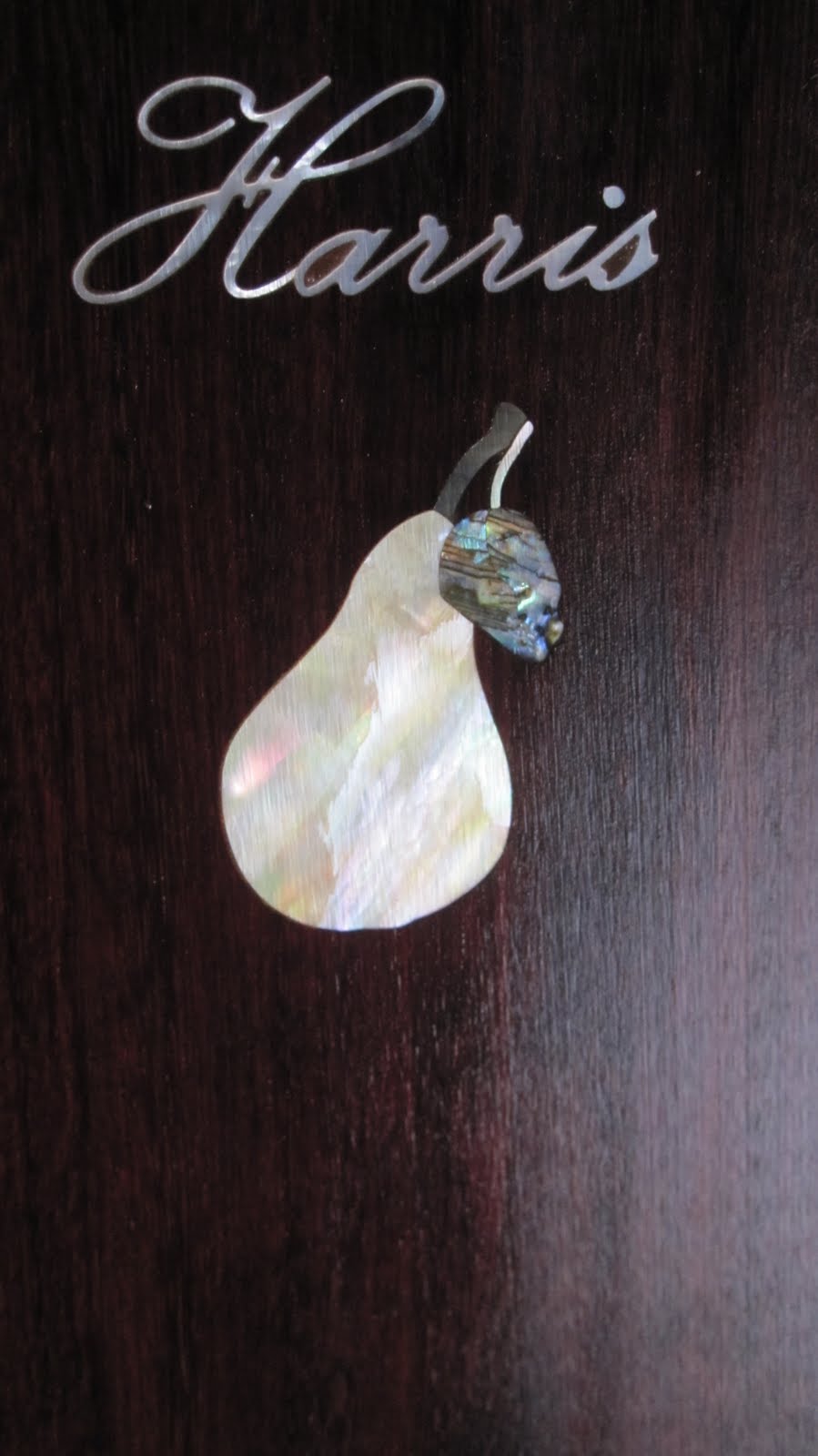
And even though my tasks have been pretty tedious lately, I got a great jolt of satisfaction when my face plate arrived last week. I think I explained earlier that the inlaying of the face plate is one step we decided to farm out. We could have done it ourselves, but it's time consuming and difficult and since the guy that did mine also does work for Gibson guitars, I figure it's good enough for me. I created the design myself and I think it turned out really well. (In case you're wondering, the pear is in honor of my father who was an artist. The pear was his symbol). When the time comes, the piece of wood you see above will be cut to the shape of the guitar's headstock and glued on.

And I think I say this in every post, but you just wouldn't believe how exciting it is to know that in a few months - unless a catastrophe happens - I'll have a guitar I built myself. That's just amazing to me. And I get a little extra motivation every week or two when a past student comes in with their instrument and I can confirm again that these are not just guitars made by amateur luthiers, but they're honest to goodness fine guitars. Unbelievable.

Wednesday, February 23, 2011

Tuning the Top


I missed two classes since my last post, but I returned to find I wasn't as far behind as I feared. My classmates are definitely ahead of me, but there's some comfort in at least having an excuse for it now. And I made quite a bit of progress yesterday, so I feel pretty good about things. The excitement of getting closer and closer to putting the box together keeps building and even though I still have a long way to go, the progress every week is tangible, and as difficult as it is for me to believe, it's getting hard to see how I could wind up with something other than a really nice guitar.

Right now I'm working on tuning the top, which is a crucial part of coming up with a good
sounding instrument. Little by little, I'm carving away the excess wood on the top braces. I still have quite a bit of carving to do, but I'm at the point now that I need to stop occasionally, hold the top to my ear and tap it to see how the wood vibrates. Already I can tell a difference each time I remove more of the wood, and the sound gets clearer and sustains longer the more I carve. The goal is to continue to remove excess parts of the wood braces until get just the sound I want.

I really love this part of the process, because it's
the part that makes the difference between a hand made instrument and one produced in a factory. Each step of the way is a decision based on feel. There is no equation, no set of defined steps and no finish line. Just a process of carving, tapping, carving some more and waiting until you feel the sound is just what you want.

I'll probably be working on this step for a couple of more weeks, but I'm just going to take my time with it. A few years from now I'll sit in my living room playing this guitar, and the work I'm doing on it right now will play a big role in determining how big a smile I'll have on my face.

Wednesday, February 2, 2011

Details, Details

It's been six weeks since my last post and I think I've made quite a bit of progress, even if I don't have much tangible evidence of it. I've been working mostly on bracing the top and back and starting to tune the braces. That's the process of whittling away the braces so that they're strong enough to hold the guitar together, but light enough to allow it to vibrate as freely as possible. I've gotten just to the point that I'll be making the final adjustments to the back next week, and I've already started fitting the back to the sides. It's amazing to think that in just a few weeks I'll be putting the top, back and sides together.

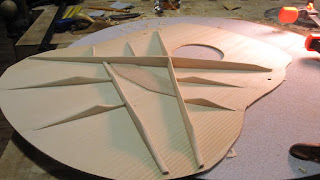
Bracing the top is a very interesting part of it all. You can see in the pictures of the top that there is a main "x" brace, which is surrounded by other smaller braces that go off in seemingly random directions. But the braces are very carefully placed to help transmit sound through the top of the guitar. They're designed to give the proper balance of bass and treble response, and although the layout is pretty standard, the precise layout is as much a matter of feel as anything else.

You may not see it in the pictures, but the braces are all linked together with notches, then glued, which explains why the process takes so long. It seems simple, but there is actually quite a bit of detail work involved in fitting them together and gluing them.


My final step this week was to begin to cut notches in the kerfing on the sides, so that the brace ramps can be fit into them, locking them in place once the back is attached. You can see the brace ramps in the picture at the top of this post. Their purpose (in addition to reducing the weight of the brace) is to fit into the notches in the kerfing. You can see the kerfing in pictures from the last post. I cut the notches this week and have begun doing the last bit of shaping of the ramps so that they'll fit into the notches, which will allow the back to fit on the sides properly. Pictures of that and more next week!


Wednesday, December 15, 2010

The Idiot's Guide to Guitar Building

As I was working on my guitar last night, it occurred to me that I've been at it for almost four months now and, at the rate we're going, it looks like that could be a third of the way there. And, despite my whining and moaning about a lack of progress lately, things are starting to come together. At least it's starting to look like a guitar.

In the past two weeks, I've glued the sides together with the end block and neck block, finished the rosette once and for all (you'll notice I declined to take picture this time - too much bad luck) and added half of the kerfing (that's the strip of wood you glue to the insides so that the top and back has a surface to which they can be glued).

It strikes me that a good deal of the work we're doing requires only modest woodworking skills. Of course it helps to have Ted looking over my shoulder so that he can stop me before I do something really stupid. And learning how to properly use a plane or a chisel is important, but it's not exactly rocket science, either. So I think it's really the tried and true techniques of guitar building that are the most important part of building a good one, rather than the amazing skill of the builder. Don't get me wrong - a fantastic craftsman is going to build a better guitar than mine will be. What I'm getting at is that, so far at least, it seems that a person with modest woodworking skills like myself can build a guitar without too much loss of self esteem. No doubt my having said that will ensure the necessity for me to complete tasks of great skill in the coming weeks. Bring it on, I say!

So it looks like the next steps are to finish the bracing of the front and back, which is extremely important. Once the braces are fixed in place, they need to be shaved down so that they're as light as possible, but still strong. Apparently, this is where the real artistry of guitar building comes in. In the final steps before gluing the top and back to the sides, you're actually "tuning" the guitar - tapping the wood and listening to it resonate, and seeking just the right sound. It's all about balancing strength with flexibility. You want to the wood to vibrate freely but not collapse.

I'm starting to get pretty excited about it all. You know my motto: "If nothing else it will have six strings and make a good drum." And it looks like it won't be long before I have my drum!

Wednesday, November 24, 2010

Patience, please.


My family would probably tell you that I'm not the most patient person in the world, but they should be happy to know that I'm experiencing excellent therapy every Tuesday night. In the latest two-steps-forward-one-step-back episode, I'm happy to report that I finally finished the outer and inner rings of my rosette.

You may recall from my last thrilling blog entry that I was beating my head against the wall trying to get the outer and inner rings of purfling in, with absolutely no luck. The problem was the purfling itself, so I finally screamed "Uncle!" and ordered the proper type.

It went in like a dream. What I had worked on fruitlessly for almost five hours was completed in about 45 minutes. Another 20 minutes trimming it up and it was looking great. Now to begin sanding the top to thickness. We're really getting somewhere now! Wait....what, you say?
Once in the sander, it became clear that the inner ring also had a problem. It was laid too shallow so that my magnificent rosette was being sanded away.

Okay. I get it. I'm being tortured.

So it's back again. I have to re-rout the channel for the middle ring - the one with the abalone - and do it over again. But no problem. I'm an expert now. I LIKE making rosettes. It's a wonderful opportunity for peaceful reflection. But it will have to wait until next time. I have to order more purfling, so joy of joys - I can look forward to doing it AGAIN.

After this experience is over, if nothing else, I'll be an expert at rosettes (something I always aspired to).

Breathe in....breathe out...

On the positive side, I made good progress on my sides. Both are now bent and one has had the laminate applied. It was a very simple process and, best of all, it worked the way it was supposed to. I think.

Patience, my son.....Patience.

Wednesday, November 17, 2010

Step By Step

It's been quite a while since my last post, for a few reasons - but mostly because I hadn't made enough progress to write about. One class was canceled, and the last few classes have been spent preparing for the work we're doing now. One thing is certain: it takes a certain amount of patience to build a guitar in only 3 hours a week. Seems I just begin to make some progress when it's time to go home. But step by step, progress is being made, and we're starting to get to the point that some of these pieces of wood I'm messing around with are beginning to look a little bit like a guitar.

In my last post, I was excited to write about the rosette I was working on. Unfortunately, that's been my biggest problem since then. You can see in the pictures from my last post that the center ring looks pretty good. But despite my best efforts (and about 4 1/2 hours of beating my head against a wall) I haven't been able to finish the outer and inner rings. The problem is that we were working with a new type of binding that just didn't work in the end. So we've ordered the old kind and I hope be able to finish that pretty quickly next week.

But I'm happy to say I managed to make some good progress in other areas in my class last week. The most exciting is that I bent my first side. That's a process that's always fascinated me and, in the end, I'm just amazed at how easy and simple it is.

I should first explain that we made the decision to use laminated sides. This would have been unthinkable a few years ago, but many guitar makers now believe that using laminated sides adds strength to the instrument without taking away from the sound quality. So instead of having one piece of rosewood about 90 thousands of an inch thick, my sides will be made of a piece of rosewood about 45 thousandths of an inch with two pieces of mahogany around 20 thousandths each layered inside.
The step you see pictured here is the bending of the rosewood piece. I had always assumed that this step was a difficult and dangerous process that took great skill and many hours. In reality, it was pretty easy and, while we let it sit for a couple of hours, it really only took about 10 minutes to do the bending.

The process is pretty straightforward: you wet the piece of wood and wrap it in tinfoil. Then you heat two rubber mats that have heating elements inside. You place the wood between the mats, cover it with a thin piece of metal, and
insert it over the form. Then you slowly clamp the center of the wood, and gradually pull the spring clamps over the ends until it's the proper shape. And that's about all there is to it. A couple of hours later, and my side was perfectly shaped. Next week, I'll bend the other side and apply the laminate to the inside, which is a pretty easy process.

I also made good progress on gluing the braces for the back of the guitar, but my readers can only take so much excitement in one post, so I'll save that for my next entry.


Wednesday, October 6, 2010

My Rosette


It seems strange that laying a rosette would come so early in the process of making a guitar, but there I was, toiling away at what one would expect to be a final cosmetic detail.

For the uninitiated, the rosette is the decorative ring around the sound hole of the guitar. Every guitar's rosette is a little different, but mine is pretty standard. It will eventually consist of several rings of purfling, including black and white fiber rings, interspersed with mother of pearl.

The first step is to rout the top so that the rosette strips can be laid in. Epoxy is then applied before the strips are inserted. The black and white binding comes in long, flexible strips which can be cut to the proper length. Once the binding is inserted (a process not as easy as one might think), the mother of pearl pieces are delicately inserted in between. The pieces of mother of pearl are short (anywhere from a quarter to half inch), so the process is time consuming. But after an hour or so, I had finished the middle ring.

And, by the way, the stains you see on the top are from cutting myself in the process. Don't let anyone tell you guitar building isn't dangerous (at least for me).

With luck, I'll finish the rosette at the next class. Then it'll be time to start attaching the bracing. Some day I may actually have a guitar!


Wednesday, September 22, 2010

My class and the joy of the 25 foot spherical radius

Gluing the top
As it turns out, I'm very lucky. Not only is my class very small, with only two other students, but both have already taken the class and finished their first guitars. That means that our class will be a little more advanced than the last and that I'll be challenged to learn a little more quickly. That's good, right? Uh....I think so.

Actually, I'm sure it's true. My classmates, Ron and Bruce have made me feel welcome in their class and have done their very best to not laugh when I ask stupid questions. I admire them already.

So far, we've made a few important decisions and have already completed some very important steps in the building process. First, we had to decide what type of guitar we wanted to build, and what type of wood we wanted to use. I had already made the decision that I wanted to build a very traditional, standard flat top guitar, so I chose to build a Dreadnought made with spruce top (red spruce in this case) and East Indian rosewood for the back and sides of the instrument. Guitar players would know this combination as very standard - like a Martin D-28, for example. That's considered by many to be arguably the standard in steel string acoustic guitars over the past 75 years or so. You'll find many bluegrass, country, and even rock and roll guitar players playing a Martin D-28 made from spruce and rosewood.

So the first three classes have involved learning a few important concepts and actually beginning the process of construction. For me, I learned something completely new in the first class. In all the years I've been admiring flat top guitars, I never knew that a flat top is not, in fact, flat - at least not in many cases, the Martin D-28 among them. Instead, the guitar is constructed with the shape of a 25 foot spherical radius. (Man, I love that). What that means is that the top and the back of the instrument are actually arched so that if the plane of the top or back continued, it would create a sphere 25 feet in radius. (Think about that for a second and you'll be able to picture it). So building the internal structure requires not only the skills of a craftsman, but a mathematician, too.

And since the top and back are both constructed of two pieces, they need to be glued together. It sounds like a pretty simple process, but planing the edges so that they join together perfectly takes a sharp plane, a smooth stroke, and lots of patience. But with a little time and many adjustments, I managed to get it done, and both pieces are glued and ready for the next step.

The other step we completed was the building of the internal braces for the top and back. This is an enormously important step, since the bracing is one of the most important factors in building a guitar that will be strong on one hand, while still being light enough to allow the guitar to vibrate freely. And THAT is what makes a great guitar. So I won't bore you with the details of our discussions about the bracing, but suffice it to say we spent quite a bit of time discussing the options and finally settling on a system of bracing that's a bit more modern than a traditional Martin would use, but still based on that basic system.

So the idea is to create two pieces of wood for both the top and bottom that create an "x". (By the way, it's somewhat unusual to use an "x" bracing system for the back, but we decided there were enough advantages to use it). [Editor's Note: In the end, and after much discussion, we decided not to use "x" braces for the back, but the standard "ladder" braces instead. "X" bracing will be used for the top]. Each of the pieces of wood used to construct the "x" braces need to be strong, yet light, so we spent a lot of time shaving the pieces down to eliminate any unnecessary bulk. Each piece is a fairly narrow strip of spruce, so they're strong and light and easy to work with. After cutting them to size, we used a jig on the sander to sand them to the proper radius to allow for what will eventually be a guitar with a 25 foot spherical radius.

Who'd a guessed?


First, there was a pile of wood

East Indian Rosewood for the back
I'm not sure exactly when I decided it would be a good idea. I think it was the culmination of a decade or more of experiences that suddenly boiled over into what many would consider a pretty crazy idea. But for whatever reason, one day it became clear to me. I was going to build a guitar.

My love of guitars is definitely not new. I remember the feeling when I got my first guitar as a boy. It was a Tama steel string, and I remember how beautiful I thought it was. I still couldn't play much on it, but I was taken with the feel of it in my hands and the magnificent grain in the wood. Over the years, I've been lucky to own some really spectacular guitars (often to the dismay of my wife, Natalie, who tries her best to understand why anyone would need 6 of them). And while my playing doesn't live up to the quality of the instruments I own, I learned a long time ago, that a fine musical instrument is much more than a tool. It's an object of fine art and craft that can stand on its own, and something that can come alive regardless of the skill of the holder.

The first big step toward my decision came a couple of years ago when I took up woodworking. I managed to acquire a chop saw, which I soon realized provided me with tool that would allow me to make some pretty cool things. My father was an artist and woodworker, so I thought that, while I had never made much of anything with my hands, maybe a talent for craftsmanship was buried somewhere deep in my DNA and only needed to be uncovered. Well, I don't know if it worked out exactly that way, but I did manage to unlock a love for working with wood, and I realized that while my skills were pretty basic, I could learn. And, most importantly, I wanted to. So I kept at it.

The idea of building a guitar was just a crazy out of reach dream for most of that time. I had read about classes for guitar building, but they were mostly far away, they required an unreasonable time commitment, and perhaps the biggest obstacle, large amounts of money that I didn't have. But suddenly the pieces fell into place when I moved to Louisville.

Since I had just left my job as director of Cityfolk, I had some extra time - at least temporarily. So I thought I would take the opportunity to take a woodworking class or two to improve my skills. And while searching for classes, my "aha" moment came when I came across Ted Harlan, a Louisville craftsman who teaches furniture building and - yes - guitar making. And what makes Ted's classes different is that, rather than a concentrated series of classes over a few weeks, they take place over the course of a year or more. It was perfect. An excellent teacher with a proven system; a reasonable time commitment; and it was affordable.

So here I am, three weeks into my new adventure. I'm taking classes every Tuesday for 3 hours, and the goal is to build a fine instrument over the next 12-14 months. Having seen the results of Ted's other students, I truly believe I'll be successful.

So this is the first in what will be a long series of blog posts about my experience. I'm not sure if anyone else will be interested in my progress, but I decided I wanted to document the process. I want to be able to sit, years later, with my finished guitar in my lap, and revisit the process that brought it to life. So here goes!